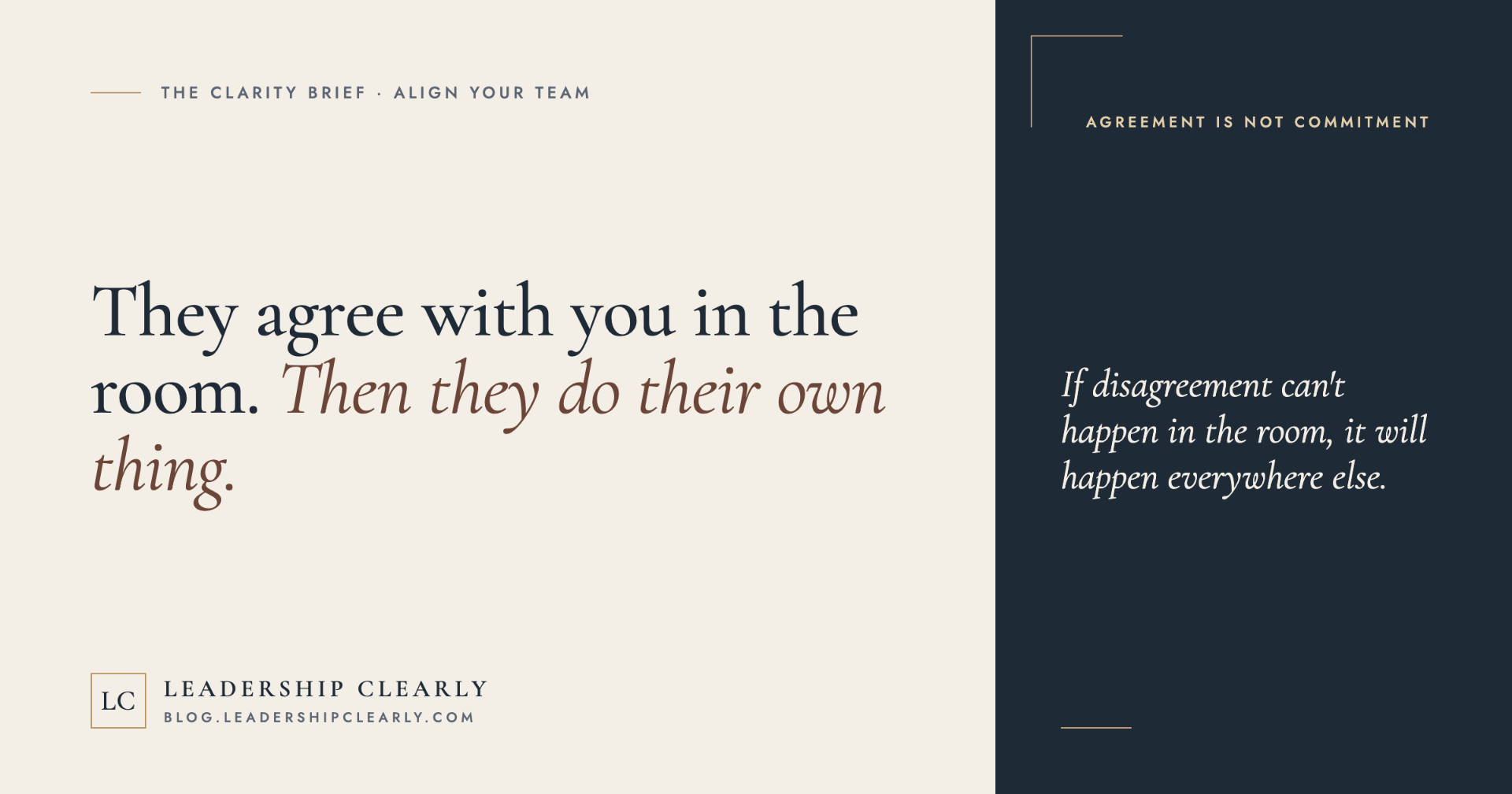
They Agree With You in the Room. Then They Do Their Own Thing.
Why your leadership team says yes in the meeting and something else in the hallway, and how to close the gap.
Julie Wagner2 min read
You brought the decision to your leadership team. You talked it through. You asked, "Are we all good with this?" and every head in the room said yes.
Then you watched each leader go back to their team and run their own version of it. One slowed it down. One changed it "a little." One quietly kept doing what they were doing before.
It's tempting to call that defiance. Usually it isn't.
Agreement is not commitment
Agreement happens in the room. Commitment happens when no one is watching. Most leadership teams are very good at the first one and have never practiced the second.
Here's what often sits behind the yes:
The real objection never got said. A leader had a concern, decided it wasn't worth the friction, and kept it. It didn't go away. It went back to their team.
They agreed with the idea, not the cost. The plan sounded right. Then they got back to their desk and realized what it means for their people, their budget, or their numbers.
They heard a different decision. Five smart people can leave the same conversation with five versions of it, and each one is sure theirs is what you meant.
Disagreeing with you feels risky. If the last person who pushed back got shut down, nobody else will try. They'll just nod and do it their way.
“If disagreement can't happen in the room, it will happen everywhere else.”
Silence in the room is not support
When a leadership team has no safe place to disagree, the disagreement doesn't disappear. It moves. It shows up as a slow rollout, a softened message, a "we'll get to it next quarter." The people below those leaders feel the tension, even if no one names it.
The fix is not more pressure to comply. It's making honest disagreement part of how decisions get made, so that when the meeting ends, the debate is actually over.
Try this before your next decision: the Disagree-First round
Then do three things:
Thank every concern out loud. If the first honest answer gets a sigh, it will be the last honest answer you hear.
Change the plan, or say why you're not. People can commit to a decision they disagreed with when they know they were heard and understand the reason.
Close with one sentence each. Ask every leader, "What will you tell your team, and by when?" If the answers don't match, you're not done.
It will feel slower. It's faster than finding out three weeks from now.
Your team isn't against you
When leaders agree in the room and drift outside it, it's almost never a loyalty problem. It's a clarity problem: about what was decided, what it costs, and whether it was safe to say no.
Get the disagreement into the room, and you'll get the commitment out of it.
Want your leadership team carrying one message?
Our Leadership Team Alignment session gets your leaders in one room to name the gaps out loud and leave with one message, carried the same way by everyone.
Take the free 4-minute Leadership Language quiz to see how you communicate, or book a Clarity Conversation. Thirty minutes, free, no pitch.
Founder, Leadership Clearly
Julie Wagner is the founder of Leadership Clearly, a leadership consulting firm that helps growing companies replace guessing with clarity: clear leaders, aligned teams, and a culture that says what it means, inside and out.
More from Julie